Tuesday, 17 August 2010

Meatballs with mash


Ingredients (for 4)

For the meatballs:
500g minced meat (beef, lamb, pork or a mixture of whatever you fancy-I used lamb for this one)
1 onion, very finely chopped
bread crumbs, about 1/2 glass (cous cous will do if you don't have bread crumbs)
a generous handful of dried mint
1 egg
cinnamon
nutmeg
salt
pepper
1 can of tomatoes
2-3 bay leaves

For the mash:
1 kg of potatoes
1 block of fetta cheese
Milk
oregano
olive oil
Optional: chilli flakes, fresh peppers or roasted peppers

Mix well the meatball ingredients in a bowl until it's all evenly distributed. If you have time to allow the meat to absorb the flavours, even better, do it from the night before, cover with cling film and keep in the fridge. It's fine if you don't, you can make the meatballs right after mixing the ingredients.

Shape your meatballs and place them in a baking dish. Add the tomatoes from the can. I usually mix them in the blender because I like a smooth tomato juice rather than chunks. Add some water, the bay leaves and bake in 200 degrees for about 30 minutes, turning once for the bottom side to brown too.

For the mash: boil the potatoes, drain them and mash them. Add milk until you have a nice, fluffy mash. Add lots of dried oregano, the crumpled fetta cheese, some olive oil and whatever else you fancy. Don't add much salt, as the cheese can be quite salty.

Serve, enjoy.

Tuesday, 3 August 2010

Sotirakis the Meek


Sotirákis sat patiently waiting for his replacement. He'd been on guard duty at the detached watchtower, looking after the .50 cal since midnight, with his shift ending at six. Six long hours in this wilderness. He didn't mind though; on the contrary, he enjoyed these long stints away from the outpost and his colleagues. He had a small torch and a battered paperback copy of Christ Recrucified in his ammo pouch, and the watchtower provided the best solitude for reading.

He'd arrived at the outpost a hot August morning a couple of months earlier, fresh from training, and he soon became the centre of attention for all the wrong reasons. Sotirákis was rather simple and quiet, the kind of person who serves as a toy for the alleviation of the outpost's boredom. The hardened veterans caught wind of his manipulable nature within 2 minutes after he'd first arrived to the outpost as a new recruit. He came on the back of the regimental Land Rover and when the corporal saw him, he simply asked him who he was, more out of curiosity, as they weren't expecting anyone. "Private Sotirákis Halloumáris reporting for duty corporal sir!", Sotirákis duly reported in fully voice and standing in attention so vigorously his back was arched and he nearly fell backwards.

The corporal was hardly a 'sir', himself far from being the alpha male at the outpost, having failed the rudimentary exams for sergeants and earning the lowest rank one could possibly earn. That made Sotirákis' response even more spectacular: the oldies knew they had a 'meek' one to play with. The corporal, after he recovered from the surprise, decided to play along.
"What's your specialisation soldier?"
"Rifleman sir!"
"That's a shame soldier. We really needed you to have more specialisations than that"
"Wh..."
"SHUT THE FUCK UP! Did I give you permission to speak?" "You only speak if I ask you a question."
"..."
"Now, as I was saying, we badly need a cook and a cleaner. Also we could do with an experienced and hardened patrol officer, do you think you can do all those things?"
Sotirákis looked at him, unsure whether to respond or wait.
"You may speak soldier" said the corporal, trying to suppress the laughter.
"I would be proud to perform these duties sir!"
"You do understand we'll have to train you-training can be hard and demanding. Are you sure you can cope?"
"..."
"You may speak soldier" repeated the corporal, rolling his eyes, incredulous at the naivety of this latest recruit.
"Of course I can cope sir" said Sotirákis firmly, while his legs started to tremble.

It didn't take long for the rest to cotton on to the fact that Sotirákis was fair game. Apart from loading him with the worst chores, cleaning, doing the washing up, doing the worst possible shifts, they played the most cruel tricks on him as well: they woke him up in a creative way every morning, ranging from buckets of water to tipping his bed over and raising the alarm. They once put a dead black snake in his bed as a joke, and Sotirákis nearly had a heart attack. If he was on guard duty when lunch arrived, they often ate everything and didn't keep any for him. They sometimes stole his personal supplies of food, drinks, soap and whatever else they liked. But he never protested, he took everything with quiet dignity, bowing his head and clearing up the mess, as if his fate had predestined him to do so.

And sometimes they just didn't turn up to relieve him off his guard shift. Like today. It was fast approaching seven and there was nobody in sight. His replacement often saw this as an opportunity to have a lie-in at Sotirákis' expense. And all he could do was sit there and wait. He was a very proper young man, to the point of suffering. His fatigue was always in order, his rifle clean, his boots polished. He shaved his young and hardly visible stubble daily-unlike some of the older soldiers.He was never late for his shift, always on time and proper. Proper, proper, proper.

He'd finished school with straight A's and already had a place in the medical school waiting for him for when all this would be over. His academic nature contributed to his being bullied, as being 'proper' and 'clever' never went down well in a world where macho posturing, boasting, breaking the rules (or saying you did) and physical prowess ruled. His quiet, reserved nature and his respect for the rules offered more ammunition to those who wanted to completely control and humiliate him. He passed as 'retarded' 'simple' 'soft' and even 'gay'. His proven academic record posed a threat to the less literate men, such as Antonís. Their insecurity made life hell for Sotirákis.

Stupid he was not. He knew that he was part of a bigger game, his place in society pre-determined. All he had to do was put up and try and belong as much as possible. He did that by laughing at the jokes, pretending he didn't mind, that he was a good sport. But inside he was burning. And he'd already started boiling that morning by the time his watch showed nine o'clock. Stavrís was due to replace him but he was nowhere to be seen. Sotirakis had been guard since midnight, he was starving and desperately needed to rest. He thought of Stavrís having a lazy morning, perhaps even being awake and sitting around with the other lads, having a cigarette and a game of backgammon. And he snapped.

When he entered the main outpost building, about half a mile from the detached watchtower, he found them drinking coffee and chatting. When they saw him they knew the game was up. Something about the death in his eyes, his demeanour, not to mention the fact that he'd done the unthinkable and abandoned his post, leaving rifle, ammo and helmet behind in his fury. Stavrís failed to read the signs. "Psaraka*, did you abandon your post? You'll get court-martialled for that" he said, his voice full of sarcasm while he was taking another sip of coffee, glancing at the rest for their reaction. Within seconds, Sotirákis had hauled him off his seat and violently planted his forehead onto his nose, dropping him onto the concrete floor in the process. Stavrís shouted and writhed, clutching his bloody face.
"And never be late replacing me again you cunt!"

Sotirákis washed himself, ate something and jumped into bed for a nap. Nobody dared to bother him until about lunch time, when the sergeant politely nudged him: "Sotiráki, come, there's some lunch for you if you want-it's OK if you don't-just have some rest, Stavrís will be doing your shift tonight".

Sotirákis was not meek any more.


____________________________
*Psarakas = (lit.) fish, can be translated as 'greenhorn' or 'fucking new guy'. In Greek new recruits are called psaria, fish, because they are 'fresh'.

Part of the Army Tales series

Thursday, 29 July 2010

Off to lift some spuds


Antonís was fed up. Really fed up. He hadn't left the outpost on leave in over a month, and the 5-6 new recruits the Captain had promised had failed to materialise, with the exception of Sotirakis. They were severely understaffed and had to do a combined 6 hour patrol and guard shift every day, including the outpost sergeant and sometimes the second lieutenant as well. Passes and leave were really hard to come by. Petros had to beg the captain to be allowed a three-hour pass every other day for his football training.

When this situation arose, the conscripts adopted various methods in order to go home. The most common one was of course doing a runner. The afternoons and evenings, when the officers had finished work, was the best time to jump the fence and hitch-hike home for some food and clean clothes. This was of course extremely risky, as being caught by the odd surprise visit by the officer-on-duty or even an external check, meant a certain court martial and a prison sentence. 

The ones who weren't lucky enough to be football or volleyball players in one of the region's clubs had to either shut up or go off sick. Going off sick wasn't easy either. Sick leave wasn't simply allowed to anyone with a mild cold,it had to be something serious. Or you had to know the regimental doctor, who could give you sick leave without asking questions. Or perhaps, you could ensure you were sick enough for a sick leave. Andreas had chosen the second way. His father, a known businessman in the area, organised frequent feasts (and brothel visits) with the regimental doctor, and was in a position to get Andreas out on 'sick leave' pretty much on will. And Andreas duly obliged-he was more or less permanently on sick leave. When his sick leave ended, he turned up at the outpost to a frosty and often hostile reception. Anton
ís hated him, as his sick leaves meant that everyone else had to patiently sit it out. Andreas knew this, and his first business after returning from sick leave was to hop on to the regimental jeep bringing the food and go see the doctor again, to his colleagues' dismay.

Antonís was determined to go on leave. He hadn't seen his fiancée in ages, and his father needed his help to collect the potatoes. His cunning plan was to acquire an injury which forced him to go on sick leave but also allowed him to do whatever he liked. He remembered hearing somewhere that if you held your hand over steam for some time, it was possible to break a finger without any effort or pain. This was probably another one of those urban legends conscripts ensured survived for generations from the times of Hammurabi's armies to our day. Unfortunately Antonís, out of school and into the building trade since the age of 13, was almost illiterate and had heard of neither Hammurabi nor his armies. 

So there he was, holding his left hand above a steaming saucepan where the lads were boiling potatoes. He had expressly instructed Stavrís to hit his pinky with the rifle butt while he held it against the kitchen sink. Any more damage and he wouldn't be able to lift the bins full of potatoes onto the lorry. He could do without the pinky, he thought, it was only a small finger at the end of the day. 

So there they stood, Stavrís with the rifle, Antonís with his left hand above the saucepan. "How long does it have to stay?" asked Stavrís. "I reckon about half an hour" replied Antonís, ridiculously over-confident. "Five minutes and we do it-are you sure you can handle it?" he asked, staring straight into Stavrís eyes for signs of fear. Stavrís' had been secretly cherishing the opportunity to smash Antonís' finger, and if anything he was over-zealous. "Sure, no problem at all. But hurry it up because I am on guard duty as well." The outpost dog, Linda, was sitting there, staring at them and patiently waiting for scraps-thinking they were cooking. 

"Let's do this" said Antonís as he turned away from the cooker and placed his hand, pinky outstretched, against the kitchen sink. Stavrís approached carefully, lifted the rifle and smashed it onto Antonís' hand as hard as possible. The loud bang, quickly followed by Linda's yelps, filled the tiny room and rang for a few seconds before the smoke and the debris from the kitchen ceiling cleared. All that could be heard was Antonís' screams of agony, as he was lying on the floor curled up and holding his left hand with his right. Stavrís had dropped the smoking rifle and was also curled up on the floor, holding his ears. The loud bang from the rifle had almost deafened them, and they couldn't hear the howls of laughter which came from the rest of the squad who had run to the kitchen door to see what had happened. 

When they finally managed to get up, they couldn't hear a thing. Kostís, the sergeant, had a notepad and was scribbling questions on it. "Can you move your finger?". Antonís nodded. "Can you bend it?" Antonís nodded again. "It looks very red but not broken to me mate-do you want to try again?" Antonís just burst into tears, more out of humiliation than pain. 

As it happened, both Antonís and Stavrís had about a couple of weeks off, as their eardrums had burst and the regimental doctor had no option but to send them off with antibiotics. They would of course be punished on return, as they discharged a rifle without permission, but for the time being they had the last laugh, although they could only hear a muffled noise. 


________________________________________
Part of the Army Tales series
Tuesday, 13 July 2010

Chaff


Mastre Hambís put out his cigarette with his boot. 'Come on boys, not much left'. The soldiers lazily got up from the comfort of the giant carob tree's shade and prepared themselves for another couple of hours of work. Mastre Hambís owned the farm right next to their outpost, and they were helping him collect all the hay bales and stack them up in storage for the winter ahead. The July sun was scorching the red earth as they reluctantly came out of the shade.

Panikkos had a soft spot for Mastre Hambís, as he reminded him of his father who was also a farmer. Mastre Hambís only had one daughter, who had married and moved to Australia, so he had nobody to help him with the farm. An old man of an age impossible to accurately guess, he had the vivacity and spring of a mountain goat. He'd often turn up at the outpost with a tray full of kléftiko and a crate of beers for the boys. It was almost as if he had de facto adopted the soldiers at the outpost. He'd seen them come and go, fresh out of training and into the boredom and solitude of the ceasefire lines, hardened, disillusioned and hopeful out into real life. On his farm he grew potatoes, barley, kept sheep and goats and had the obligatory fruit garden, so common a pattern in the region. Whatever the season, there was something to harvest, something he needed help with, but also something he could offer the boys. Oranges, mandarins, potatoes, peaches, apricots, plums, water melons. They sometimes pinched some fresh milk from the jars he put out for the dairy collection. His contribution came to substitute the dreadful slops the regiment's kitchen insisted on calling food, a pile of something or other which arrived at the outpost in a tin container at the back of a truck, covered in the red Mesaoria dust. The contents of the tin pot inevitably became food for the six or seven dogs and puppies the soldiers kept at the outpost.

They hopped on the cart drawn by Mastre Hambís' tractor and he led them to a field about a mile from the main farm. The hay bales, cubic beasts peacefully sunning themselves, were waiting to be collected. Mastre Hambís parked the tractor in the middle of the field, and the boys started stacking them onto the cart, hauling them from the two plastic strings they were tied with, their heavy boots clumsily stumbling in the caked earth. It was hard work, the sweat was pouring down their bare backs, bits of chaff and dirt covered their bodies and faces, making them look like those images of the peasants of a bygone time. Their youthful bodies were so tanned they had the appearance of leather, their eyes burning bright from under the dirt.

"Aman kopelia*! We're fucked!", exclaimed Andrikkos. They all turned and looked at the cloud of dust following the fast-approaching regimental Mercedes jeep. There was no point trying to either hide or pretend they were on a patrol. Their weapons and kit were left behind at the outpost-they were there to carry hay bales. They just stood there, waiting for their approaching fate. The sight of the Mercedes usually meant the regiment commander or, even worse, the battalion commander, a development which would surely land them in court-martial.

The jeep pulled up and out came Lieutenant Hristofís with a folder in his hands. Their despair started evaporating, because the only person who could possibly let them off lightly was him. Hristofís was a mild-mannered chap who was clearly in the wrong profession as he couldn't harm a fly. His dream was to be a primary school teacher, but he got his exam preferences mixed up and ended up in military school instead. He was always bossed about not only by his superiors and his peers, but also by the odd conscript who overstepped the mark and gave him a hard time. The only time he punished a conscript, because the presence of the commander gave him no choice, he offered a tearful apology afterwards.

"Hey guys, what's up?", he asked as he approached the boys with his folder under his arm. "I went to the outpost and the lads there sent me here. Did you all become farmers now?". "Erm, Mastre Hambís here needed a hand sir, so we did it out of boredom. I hope you don't mind" said Kostís, the sergeant and technically the person responsible for the squad. "That's fine, I didn't see anything", replied Hristofís "as long as the commander doesn't get wind of this, he'll have your balls on a plate". Swearing just didn't agree with Hristofís, and the word 'balls' just sounded odd coming from his lips, even in an environment such as the army where swearing was common speak.

"They are very nice lads Mr. Hristofís, they were giving me a hand, I hope you don't mind", added Mastre Hambís. "No, that's fine, just don't say I said so" smiled Hristofís. "Anyway lads, I'm here for your payment". The statement was immediately followed by loud cheers which echoed in the almost desert-like landscape. The conscripts only received about £20 per month, barely enough for cigarettes, but pay day was always a good time nonetheless. "Thank you re Hristofí!*" they said, patting him on the shoulder, as if he was a mate who'd come back with cans of lager. After they'd all signed the form and pocketed their money, Hristofís jumped in the jeep and he was on his way to the next outpost.

They returned to their job with renewed vigour and in a good mood, quickly throwing the bales onto the cart. Mastre Hambís smiled from under his moustache. The sun was beginning to dip to the west, and the sea breeze was finally starting to blow.


______________________________________

*Aman kopelia = god help us lads
* re = you, hey you, mate

Part of the Army Tales series

With thanks to KnifeJuggler for the photo

Wednesday, 7 July 2010

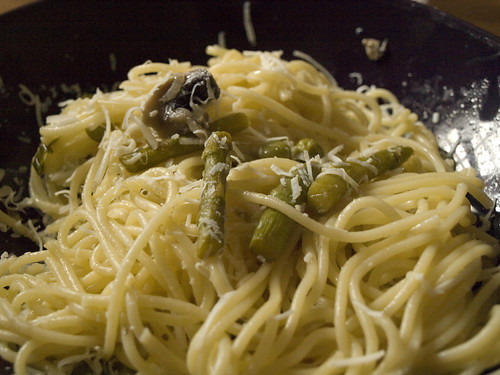
Spaghetti with Asparagus, Peas and Mushrooms

Spaghetti with asparagus, peas and mushrooms

Simple recipe this one, but so tasty...

Ingredients (serves 4)
1-2 bunches of asparagus (the thinner the better)
a few mushrooms (chopped)
some peas
2-3 spring onions, chopped
chilli flakes
olive oil
butter
white wine
salt

500gr spaghetti


Wash the asparagus and cut off the harder part of the stem if it feels too hard to cook. Alternatively you can slice the harder part right through the middle. Cut the asparagus in pieces of roughly 2cm each (that's less than an inch you imperials).

In a frying pan, heat some olive oil and toss in the asparagus. Add butter, peas, spring onions and chilli flakes. Cook for 4-5 minutes, drizzle some white wine, add the mushrooms and salt. Turn the heat down and cover, allowing it to cook gently for another 5 minutes or so. In the meantime...

In a saucepan add water, salt and bring to the boil. Add your spaghetti and cook for as long as you like-preferably the time advised on the pack.

Drain the pasta, return it to the saucepan and tip your asparagus sauce in. Mix gently and serve with some nice parmesan cheese. I use mature anari, a Cypriot cheese. Drink the rest of the wine with it :-)

Tuesday, 6 July 2010

Καρτερόντας τους βαρβάρους

Σε ελεύθερη μετάφραση.

Περιμένοντας τους Bαρβάρους

Καβάφης Κ. Π.

Ίνταμπου καρτερούμεν, συνάμενοι στο παζάριν;

Εννά φτάσουν οι βάρβαροι σήμερα.

— Γιατί έτσι κουνοσσυλιόν μες την Σύγκλητον;

Ίντα κάθουνται οι Συγκλητικοί τζιαι έν νομοθετούν;


Γιατί οι βάρβαροι εννά φτάσουν σήμερα.

Ίντα νόμους να κάμουν πιον οι Συγκλητικοί;

Άμαν έρτουν οι βάρβαροι εννά νομοθετήσουν.

—Γιατί ο αυτοκράτορας μας εσηκώστην που το χάραμαν του φου,

τζιαι κάθεται πας της πόλης την πιο μιάλην πύλην

πας στον θρόνον, επίσημος, με την κορώνα πας την κκελλέν του;

Γιατί οι βάρβαροι εννά φτάσουν σήμερα.

Τζιαι ο αυτοκράτορας περιμένει να δεχτεί

τον αρχηγόν τους. Τζιαι μάλιστα ετοίμασεν

για να του δώκει έναν χαρτίν. Τζειπάνω

έγραψεν του τίτλους πολλούς τζιαι ονόματα.

— Γιατί οι θκυο μας ύπατοι τζιαι οι πραίτορες εφκήκαν

σήμερα με τες κότσιηινες, τες κεντημένες τόγες·

ίντα εφορήσαν βρασιόλια με τόσους αμεθύστους,

τζιαι δαχτυλίθκια με λαμπερά, γυαλλιστά σμαράγδια·

ίντα επιάσαν σήμερα πολύτιμα μπαστούνια

με ασήμια τζιαι γρουσά όμορφα σκαλισμένα;

Γιατί οι βάρβαροι εννά φτάσουν σήμερα ·

τζιαι τέθκοια πράματα θαμπώννουν τους βαρβάρους.

—Γιατί τζιαι οι άξιοι ρήτορες εν έρκουνται όπως πάντα

να φκάλουν τους λόους τους, να πούν τα δικά τους;

Γιατί οι βάρβαροι εννά φτάσουν σήμερα ·

τζιαι τούτοί βαρκούνται τες ομιλίες τζιαι το λαφαζανιόν.

— Μα ίντα άρκεψεν άξξιππα τούτη η ανησυχία

τζιαι η σύγχυση. (Ίντα σοβαρά που εγινήκαν τα πρόσωπα).

Ίντα φκιερώννουν γλήορα οι στράτες τζιαι οι πλατείες,

τζιαι ούλλοι γυρίζουν έσσω τους πολλά συλλοϊσμένοι;

Γιατί ενύχτωσεν τζιαι οι βάρβαροι εν ήρταν.

Τζιαι εφτάσαν μερικοί που τα σύνορα,

τζιαι είπασιν πως έν έσιει πιον βαρβάρους.

__

Τζιαι τωρά ίνταμπου εννά γινούμεν δίχα βαρβάρους.

Οι άνθρωποι τούτοί ήτουν μια κάποια λύση.

Thursday, 10 June 2010

The dining table of life


As someone who lives abroad, I always dread phone calls from Cyprus announcing losses of loved ones. It's the fate of the voluntarily (or involuntarily) displaced. They always tell you that [insert name of loved one here] is in hospital and it doesn't look too good. Half the times your loved one is already dead and they're just trying to soften the blow. It doesn't work of course, it just makes it easier on the unlucky messenger to deliver the dire news.

Just over two years ago, I lost my grandmother. She'd fallen and broken her hip bone, they operated on her and apparently it went well. 'Yiayia' was always afraid of anything remotely related to death however (she'd stopped going to funerals decades earlier), so when she was in the clinic she decided that it was probably her time to be on her way. They said that she kept saying thing like "I'll be seeing my Kostis soon" (her dead husband). I suspect that her death was partly due to her frail condition (she was 96) and partly a conscious decision-she'd simply had enough.

In her final years her eyesight had started to fail her, and she gradually lost her hearing. I loved her very much though, and she always recognised me and asked me whether I'd found a wife yet (Firfiri you are not alone). She only knew how to read a little bit, hadn't gone to school, worked the fields and raised children all her life. She always sat on an old-style chair outside her door, looking at the gate. Every time I passed from there, on a bicycle (childhood), moped (teens) and more recently in a car, I'd turn my head and see the figure clad in black sitting there, enjoying the breeze. It was reassuring somehow, as if my own roots were still secure, firmly in the ground.

When my brother rang and told me the bad news, I kept my composure up until I hung up. I then cried bitterly, like I'd never cried before. By the time I heard the news they'd already gone ahead with the funeral and it was all over. I never told them this, but I was upset that they didn't at least allow me a day to get there for the funeral. I don't know, somehow I wanted to be there and go through the grieving process with the family, and especially my dad who lost his mum.

When I go to Cyprus, we always gather for family feasts. I think it was last year, or perhaps the one before, when I noticed that my brother's children are now sitting where my brothers and I used to sit when we were children, at the edge of the table. Where my parents/uncles and aunts used to sit is where our generations sits now. My parents sit where my grandmother used to sit, as if the conveyor belt of life is slowly but surely moving us from one end of the dining table to the other. The dining table itself is life. I must say that the hairs on the back of my neck stand upright every time I think of the concept. Life is a dining table, and as we grow older, we shuffle down to make space for the next generation. Figure that one out.

Every time I pass outside yiayia's house, I always look, as if I am still expecting her figure to be sitting there.


[Apologies it's a bit of a sad one-I promise you a nice recipe to make up for it]