Wednesday, 19 January 2011

Nutters I have known #3: The Greek 'researcher'


Soula was very keen on her research. She was researching her own island (aren't we all) during Ottoman times, but nobody knew exactly what. You see, Soula thought that what she was doing was so important and significant , importantly significant and significantly important that somebody might steal it from her. Therefore, she never told anyone apart from her PhD supervisor what her research was about. Which was a bit extreme.

You see, unless you're researching the cure for cancer or a revolutionary PC software/hardware which will change the face of the planet, nobody cares. Especially if you're researching a small Greek island (not Cyprus btw). Anyway. Soula was so obsessed with secrecy, that when we had student conferences where we presented our work, she wrote a paper on something irrelevant in order to avoid revealing her real topic. On top of that, she confused research with collecting material. She'd go to archives and photocopy everything, accumulating piles and piles of photocopies of documents whose only value was that they could one day prove useful. They didn't. Her supervisor told her to stop it and concentrate on finishing her thesis.

When she finished her thesis, passed her viva and submitted it, she made it inaccessible to anyone for 7 years. Because although there was a date on it and it was printed and bound, someone might still try to steal the supreme knowledge included in her thesis. As a result, by the time her thesis was available to readers, nobody was interested any more. She went back home, found a job in local government and that was that. The world could not benefit from her cutting-edge work. Shame ;-)

The Nutters Series

Monday, 20 December 2010

Bread


The reason I insist on baking bread is that in the UK bread is either not good or expensive for what you get. In addition, I believe that baking bread is one of those ancient skills, it has a certain mystery, it is a ritual and a basic function of human existence. After the sermon, here's the recipe:

Ingredients
Roughly 800gr flour (I used strong white flour)
1 sachet dry yeast (if you have sour dough, hats off to you)
A pinch of salt
1 tsp sugar
Sesame seeds 
Poppy seeds

Dissolve the yeast and sugar in about 400ml of lukewarm water. Allow it to rise and froth for about 15 minutes. Run your flour through a sieve and into a large bowl. Mix in the salt. Slowly add the water/yeast and knead, until you have a nice, workable dough which is not too moist or dry. Add flour or water to bring it to that desired consistency. Cover it and allow it to rise for about 30-45 minutes. I put mine next to the radiator.

I made little bread rolls, as my electric oven (fan) bakes these better than big loaves. Make your bread/rolls by cutting off enough dough. When you're done shaping it, dab one side with a wet towel and then dip it in a flat plate where you'll have mixed your sesame and poppy seeds. Place your bread on a lightly oiled and floured oven tray. Cover and allow to rise for another 15-20 mins. In the meantime, preheat the oven to 200 degrees. 

Bake your bread for about 25-30 minutes (if small rolls) or about 45 for a larger loaf. Again, ovens vary so trial and error will probably determine these for you. 


Made with Slideshow

Thursday, 9 December 2010

Nutters I have known #2: the pseudo-intellectual


[I had forgotten about this series, until Claude reminded me-thanks!]


Makis was an intellectual. One of those you know the moment you lay eyes on them. Short, dark, with John Lennon glasses, always clutching a book. I met him when I was an undergrad, and he drifted in and out of my life and those of others (I am sure Antonis will have something to say).

This guy had his head in the clouds. He always liked to maintain a certain high ground, intellectual, deeply thoughtful and always supposedly mildly surprised and amused by life's little real moments. I suspect that he thought that the intellectual ticket would get him laid. He did his best to impress the ladies, always quoting this poet and that, speaking with flowers and doves in a manner so detached you could be forgiven for thinking the man was ethereal. I guess that the way he wolfed down his bowl of pasta or his chicken (which you'd cooked for him) was the only thing that allowed a tiny little beam of doubt to cast some light on the mystery...

You see, Makis liked to pretend he was an intellectual. His knowledge of poetry, philosophy, history, literature and literary criticism, sociology, politics and all things contained in the space between book covers proved to be superficial, time and time again. When probed, it turned out that he had a good encyclopaedic knowledge on which academic published with which publishers, when and where. But not what. If you asked him carefully, it turned out that he hadn't actually read any of the things he knew about. A bit like knowing about Mount Everest-you know it's there, but the air of authenticity disappears once people realize that you have never set foot on Asia.

He was perfectly happy to eat like a true Cypriot if someone else had done the cooking. If not, he pretended to lead this intellectual life, where food interfered with reading time-so he bought himself bags of lettuce and carrots, claiming that these stimulated his mind etc. And he could talk. If talking was a sport, Makis would have been World Heavyweight Champion of Talking. Talking Crap. The best retort to him came from a very old academic one day in the foyer of our faculty. We were sitting at a bench and Makis was clutching a literary criticism book, to which the man said: "you should stop reading that and start reading literature". Spot on.

And then there was his attitude to women ("he treats objects like women man"). You'd be standing there, having a casual chat with him, and all of a sudden he'd stop, turn his whole body and stare, following in this manner the movements of this pretty girl who'd happened to pass by. No sign of being discreet-just staring like a man who'd been in prison for 40 years, to the point it was embarrassing to be with him in public. Staring doesn't begin to describe it, I guess he was like a dog who'd just seen a 6ft tall bone walk right past him, drooling and all. Embarrassing.

The last I'd seen of him was when I was moving out of my house. We let him stay with us for a few weeks because he had no place to stay (mug? moi?). As we were waiting for a taxi to come and pick us up, he appeared, book and lettuce in hand. "Makis, give us a hand mate, will you?" And then came the immortal response: "Mate, I'm sorry but I'm an intellectual. I don't do lifting". And that was that.

He's of course nowhere near as colourful as our Basque friend. You'd have to meet him to appreciate his full madness. I hope you don't-you'll be stuck there all day, and life's just too short.

Thursday, 2 December 2010

Bah humbug! No World Cup for England. Back to the protests then.


What disaster! What a huge injustice and monumental failure of the system to send the 2018 World Cup to the home of football. What a blow to the English (British) economy.

As the tabloids (and not only) are screaming at the perceived injustice, I must tell you that I for one thing am happy England didn't 'win' the right to organise the 2018 World Cup. There are a number of parameters here, and a number of reasons.

Firstly, there is nothing here on the level of states. FIFA are a corporation, milking the World Cup to the extreme. An extremely corrupt club for that too. The way royalty, politicians and others got involved in the England bid you'd think this had something to do with the public. It doesn't. World Cup football (and Premier League football while you're at it) are privately run entertainment events with the sole purpose of generating their owners and their partners maximum revenue. There is no morality here to be broken. Private business is profit-driven, end of story. I for one thing would not be happy to pay for the infrastructure, policing and security which would facilitate FIFA, Coca-Cola, Adidas and the rest of them to reap maximum profits.

Which brings me to my second point. All the arguments we hear about all the revenue that would come in, the tourism, the jobs, have no real foundation whatsoever. There has been no estimate (published at least) of the projected costs of hosting the World Cup. According to Panorama last Monday, the Dutch have in fact undertaken a study and it turns out that when FIFA and their partners have taken their profits, the nation would be £100 million worse off. On top of everything, the Dutch weren't favourites as they were unwilling to change their legislation to satisfy FIFA's demands or allow FIFA tax exemption during its activity in the Netherlands. Benefit? Bollocks. That's just sheer populism.

Thirdly, the cries against corruption on the part of the British media are only coming out after the English bid failed. In fact, I suspect that some of those bent officials who were exposed in Panorama would even be voting for England. Make no mistake: the English bid and its proponents were fully aware-nobody was robbed of anything here. The English have simply been bested at this game by others. The World Cup will be well placed in Russia.

The above phenomena exist whenever there is a huge sporting event with global appeal, it's nothing new. How did an impoverished country with sky-high crime rates get to organise the World Cup last summer? What happened to the infrastructure now it's all over? And have the townships, crime and poverty been eradicated as a result of the World Cup's all-healing impact? We don't know, as the patronising, flatulent journalists who were there during the event are not interested any more. And don't you think that given Joao Havelange's grip on FIFA for decades and his association with cases of bribery, it is hardly surprising that Brazil also got to organise the World Cup in 2014? Will the World Cup eradicate the favelas of Rio? Allow me to be deeply sceptical, although I'm sure it was also part of their bid: the social project, the benefit, the impact.

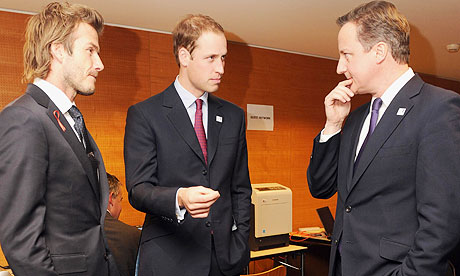
If you think these big events give economies a boost, think again. The only ones who get a boost are politicians who get to milk the glamour and the fireworks and the multinationals who really run the show. It is disgraceful for the prime minister of a nation hit hard by budget cuts to be throwing his weight behind what is simply a nice celebration of back-scratching and keeping money in the family. The inappropriate excitement about the World Cup bid, just like the pompous announcement of Will's and Kate's engagement, only serve to temporarily shift our attention from the more pressing issues. Unemployment, unfair distribution of taxes, further social exclusion in health and education, accommodation of an upper-class-run exclusive club of politicians, businessmen and their friends. Bread and circuses don't save the day. Just ask a now-bankrupt Greece. The Athens Olympics were only six years ago. And although the Olympics served to temporarily tranquillise them and make them forget the state of the economy, they soon woke up again. The British will too. Good luck to the Russians-they'll need it once Blatter and his partners are done chucking all the sacks of roubles into the truck...

Saturday, 27 November 2010

Pasquale's Mussels and Spaghetti with Mussels


Not my recipe this time, but rejigged and reblogged from Ιστομαγειρέματα. Thanks to postbabylon for this.

How to clean and prepare live mussels
Take the mussels and pull gently but firmly the little 'beard' they have. When you do this, the mussel closes.
DISCARD the ones that haven't closed after a few minutes. Give them a good wash, cleaning them of barnacles and whatever dirt they may have. Ready to cook.

For Pasquale's Mussels (serves -in our case 2 +2 next day)
1 kilo of mussels
1 large onion or 2 small ones, chopped
2-3 cloves of garlic, chopped
1 can of tomato + 1 carton of passata (if you have nice and over-ripe tomatoes it's clearly better)
2 whole dried chili peppers (or chilli flakes)
Salt & pepper
The original said sugar, but I didn't put because I used...
...1/3 of a bottle of medium white wine
Fresh parsley if you have it, chopped

In a large saucepan sauté onions, garlic and chili peppers in some olive oil. Add the tomatoes with a drop of water (if you're using passata) and allow to simmer for about 10 minutes, or until it's reduced. Add the mussels, wine and salt & pepper, and allow to cook for about 15 minutes (they say 5 for mussels but I'm not taking any chances). All mussels should have opened by now. DISCARD any that haven't opened-getting food poisoning isn't worth it :-)

Serve with some rice and sprinkle your freshly chopped parsley on top.

Spaghetti with mussels (or mussel sauce)
You will have either a fair quantity of mussels left, or maybe just the sauce.

Re-heat the mussels. In another saucepan boil some spaghetti. Drain the spaghetti and return to the saucepan. Using a soup ladle, take the mussel sauce and mix it with the spaghetti, until you're happy it's enough. Serve the spaghetti with the mussels on top. Italians in general don't go for grated cheese with seafood, but Mrs M. grated some parmesan none the less.


Made with Slideshow Embed Tool

Friday, 19 November 2010

Procrastination


Κυπριακά δαμαί

How procrastination works (a real case study)
You're sitting at your desk, working on something important (a job application in this case).
You feel like having a cup of coffee.
You get up and go to the espresso machine. You press the button and realise that the machine is getting a bit clogged up, it could do with some cleaning at some point.
You find the leaflet with the instructions (you can see where this is going, can't you?)
You open the cupboard where you keep the tools. You take out the little case with the screwdrivers. You unscrew the filter head, give it a good wash and screw it back in. 
You put the tools away. You heat the water, put coffee in the filter and make yourself a nice, double espresso.
You sit down again.
You blog your findings for the benefit of the procrastinating masses out there.

Monday, 15 November 2010

Pizzas pizzas pizzas


In Cypriot here.
My friend Antonis was here for a few days and one night we made a few pizzas with Federica's dough recipe.
600 gr. of village flour made 3 large ones.

Pizza the First

We topped the first pizza with:
Courgettes, cut in strips and grilled in advance
Anchovies
Artichokes (from a jar)
Olives
Mozzarella

Pizza the Second
For the second one we roasted in advance half a butternut squash with some butter, garlic and sage leaves in the cavity. When it cooked we melted it onto the pizza base (instead of tomato) and topped it with:

Sage leaves
Red onions
Brie (in place of goat's cheese)
Balsamic vinegar

Pizza the third
We made the third one in two halves with whatever was left. Half we topped with anchovies and the other half with ham. Then we added:
Fresh tomatoes
Artichokes
Red onions
Parmesan rind
Mozzarella

I made the snail for my little girl with the rest of the dough. She had fun, I baked it and she ate it (until we go back to Cyprus for some real snails).
The pizzas were lovely. I'd invite you round but we polished them...